
The New Covenant Temple of God
Published May 29, 2026
Why should Christians care that the church is God’s temple on earth?
Believers easily pass over this truth because we don’t really understand it in its full biblical context, but a correct application of the temple imagery in 1 Corinthians 3:16-17 is crucial for the New Covenant Church.
When we consider God’s temple, our minds usually travel to a physical structure, starting with Solomon’s temple, or the rebuilt temple after the exile, or Herod’s temple. We also think of the destruction of that temple in Jerusalem by the Romans, and perhaps of what’s left of that building.
When we hear that the church is the temple of God, most Christians accept this truth, but almost as a secondary type of temple – maybe even inferior to the one in Jerusalem. Some think this phrase is simply a metaphor, and the physical structure in Israel will return as God’s true temple. This understanding, however, is not a comprehensive biblical view. The church is not understood in the Bible to be inferior – but superior – to Solomon’s or Herod’s temple.
So, where should we begin when thinking about God’s temple.
We must start where God’s true temple is located – in heaven.
In Psalm 11:4, David explains how he can speak of God’s building while there was no earthly temple building when this passage was penned. David knew the authentic temple where God dwells is not a geographic building we can find on Google Maps, but it is in the heavenly realms.
In the book of Acts, Steven told his accusers that though Solomon built the Lord a temple on earth, God does not dwell in a building made by human hands. Rather, God resides in heaven, which is the location of His temple and throne. This is an amazing picture of God being so infinite and glorious, filling heaven, and reaching down to His footstool – the earth. God can’t possibly dwell in an earthly structure because He fills all creation.
So, why, then, did God dwell in earthly structures?
Before the fall of man, God walked among His creation. The garden of Eden functioned as a sort of a temple where Adam and Eve fellowshipped with God. After the Fall, however, everything changed. The Lord rarely came among humanity. His presence vanished from sinners.
With the Exodus, though, God called a special people to Himself to be a holy nation, where He might pitch His tabernacle and dwell among them. Here, God began to restore His fellowship with man after the Fall.
The tabernacle functioned as the first prototype of the temple – the place where God’s glory dwelled among His people. Eden was not restored, but God’s presence would once again be manifest among His people through the tabernacle. For the first time since Genesis 3, God was manifest on earth in a consistent place as He led Israel through the wilderness.
Hundreds of years later, David desired to build a permanent temple for God, but his son Solomon would be tasked with the responsibility. After the completion of this project, the Lord’s glory dwelled in Solomon’s temple rather than the tabernacle.
Because of Israel’s failure to keep the Mosaic covenant, the Lord’s glory tragically departed from the temple. This event occurs in Ezekiel 10-11, as God’s glory moves from the holy of holies to outside Jerusalem, leaving the temple. Of course, the exiles returned after 70 years to rebuild the temple, but God’s glory never returned. The temple’s completion and dedication in Ezra 6 are markedly different than the tabernacle and Solomon’s temple because no cloud descends, no glory is seen, and God did not dwell among His people.
For about 500 years, God’s glory remained absent… until Jesus tabernacled among us (John 1:14). The temple imagery resumes with the Incarnation of Christ! God’s glory that had left the temple in Ezekiel’s day returned, but this time it did not manifest in a building but in the person of the Son of God.
Most of the Jews during Jesus’ day were unable to comprehend the idea of this perfect temple. One day, when asked for a sign for His works, Jesus said He would raise up the temple in three days, which the Jews misunderstood because they were fixated on the physical building (John 2:19). In fact, one of the false charges against Jesus during His trial was that He sought to destroy the temple (Mark 14:58).
This discrepancy between the physical and spiritual temple of God was also at the heart of the debate between Jesus and the Samaritan woman, who wondered which was the true mountain of God’s dwelling (John 4). Jesus’ response was telling: God’s temple would no longer be geographically situated. The Lord’s dwelling was not going to be in a building or on a mountain, but in a people who embraced the Messiah by faith and received His Spirit.
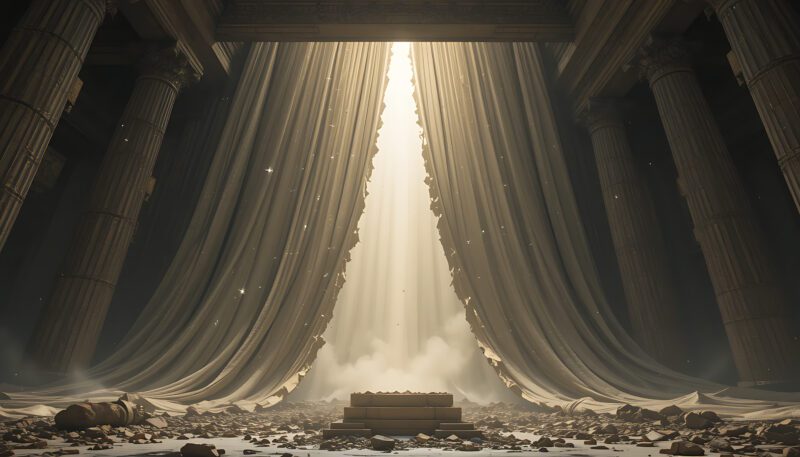
To put an exclamation point on the reality that the physical building was no longer necessary, God did something extraordinary at Christ’s death (Matthew 27:50-51), destroying the temple veil. This action is rightly understood that the way to God was open to all who believe through Christ’s death. Something else happened here, though. The rending of the temple veil also demonstrated the way to God’s presence through the temple structure was now meaningless. Christ’s body is forevermore the true temple.
Now, we might ask why these buildings were necessary if they ultimately would be replaced with the body of Christ. The author of Hebrews informs us that the physical tabernacle and Solomon’s temple were copies of the heavenly things (Hebrews 9:23-24). Since Jesus came to earth, the copies are outdated and unnecessary because we have the substance in Christ.
Jesus foreshadowed this truth when he said that something greater than the temple was among the Jews during His ministry (Matthew 12). Christ could make this claim because He is God’s true temple! It should not be lost on readers that the only gospel that records this statement is Matthew’s Gospel, which was written to the Jews to realign their attention from the building to the Builder.
So, now that Christ has ascended, where is God’s temple?
Paul is clear in 1 Corinthians 3, that God’s temple is not a physical structure now that Christ has come, but it is the church indwelled by the Holy Spirit. The body of Christ is still God’s temple, and we as the church are the manifestation of His body on earth. God called the church to be a taste of heaven on earth – because the true temple is in heaven.
Christ came from heaven as the true temple, and He has returned to heaven, leaving Christians as His body on earth, where God’s glory now dwells. Anywhere God’s blood-bought people gather as the church as God’s temple, there they may discover the Lord’s presence, and there His glory dwells through the presence of His Spirit. How amazing to think that God’s glory is not confined to one geographical location.
The climax is that the church of Christ is not the final temple, but that the final temple is coming with the new creation. Revelation 21:3 informs us about the new heaven and earth, and the glorious temple, where God will forever dwell among us as His redeemed people. There will be no more tears, death, crying, or pain. Everything from the fallen creation will have passed away.
The amazing thing is that the temple in the new creation is not a building, but it is God (Revelation 21:22). The Lord’s presence will fill all creation, so His glory is seen everywhere in the new heaven and earth. Heaven and earth will meet, and God’s glory will dwell among men. This is the inevitable trajectory of human history.
God’s presence in His temple thus extends everywhere the church exists throughout the world. And the day is coming when all creation will be consumed with God’s glorious presence, and He Himself will be the temple – and we will dwell with Him forever.
Related Posts
Reflections
Responding to Sin in the Church, Part 1
July 23, 2026
Reflections
A Call to Spiritual Maturity
July 15, 2026
Reflections
Fools for Christ’s Sake
July 9, 2026
0 Comments